 This afternoon, I was walking to my professor's apartment in downtown Kolonaki (the area of Athens I live in) to babysit her two year old, and when I turned onto the main street, which has quite a few ultra-swanky stores, I was shocked to see that the storefronts of almost every single store had been smashed, along with the windshields of some cars parked on the street. It seems that just two hours earlier, a group of about forty anarchist youths had run through the streets of Kolonaki's shopping district with sledgehammers, smashing everything they could.
Only two hours after the fact, some people were already replacing the glass, while others just stood outside surveying the damage or milling around in the street. Apparently most of the same shops were destroyed, burned, and looted only three months ago in mid-December, which may have accounted for the grim resignation on most people's faces.
There were hardly any police to be seen, and when I heard a horrified American tourist couple ask a bored and resigned-looking clerk smoking a cigarette on her store's stoop why the police weren't there and hadn't done anything, and she just shrugged and explained, "the police never do anything. It's not a surprise."
This was interesting, because when I first got to Greece, I wondered why there were so many policemen, wandering around in clumps and hanging out on street corners, but I never saw a single one stopping anyone for not wearing a helmet on a moped (which is required by law but about half of all riders don't wear them) following the speed limits, or running
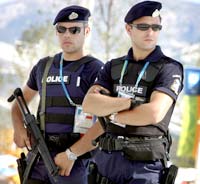 red lights-- especially as many Greek drivers like to do all three simultaneously. In all seriousness, I asked one of my professors whether Greece even HAD a speed limit, and she just laughed and explained that of course there is a limit-- it's just never enforced. The police apparently don't think it's their job to do day-to-day things like traffic stops or busting underage drinking (not that there's a drinking age in Greece, but still)-- they're there for the "big" situations, which I guess is why spend a lot of time standing around looking intimidating and showing off their automatic rifles. I do have to give it to them-- it's generally pretty tough to look scary in a beret, but they definitely pull it off.
Good example: about a month ago, I found a wallet with no money in it (of course) but still containing some ID cards that, given the world-famous efficiency of Greek bureaucracy, would probably be agonizingly difficult for their owner to replace. My first impulse of course was to give it to the policeman I saw about a block away, but when I tried to hand it to him, he looked at me like I was crazy and asked, (and I was SO proud that I understood this in Greek!!!) "What? What do you want ME to do with it?" I gave up and just took it to my school and let them deal with it, but it was a very strange experience.
Anyway, given that there are usually clumps of policemen on every major corner, and that they are only around for the "big problems," it seemed odd to me that the police clearly had made a minimal effort to stop the youths, as they were able to completely destroy the storefronts of at least five blocks that I saw in broad daylight in the middle of a weekday.

I think the most surprising thing for me was how little emotion the shopkeepers or people on the streets were showing, besides the horror-struck tourists. They were certainly upset, but in a much more resigned way than I would have expected after a similar event in America. To them, I guess this was just another in a long series of disappointments and senseless destructions that they had dealt with before, and had come to terms with the fact that they would likely be suffering from again. Some of the shops had already begun to replace the broken glass, only two hours after the attack. I couldn't decide whether this attitude was positive in a "the show must go on" kind of way, or depressing in that everyone seemed so resigned to the fact that these problems are not going away anytime soon.
I'll go with the positive, but that might just be the American optimist in me.


No comments:
Post a Comment